
Local stories · History & culture
Colonial Quarter St. Augustine: Where History Comes Alive
A forge, a historic home, and a cannon’s roar: our local look at an experience that keeps St. Augustine’s past in the present.
Words & film by See St. Augustine · October 5, 2026 · 6-minute read

Walk down St. George Street and it is easy to admire St. Augustine without slowing down long enough to understand it. The buildings are beautiful. The stories behind them deserve just as much attention. At the Colonial Quarter, those stories have a voice, a spark, and occasionally a very loud punctuation mark.
On our filmed visit, our guide carries the group from a blacksmith’s forge to an old house, through the realities of crossing an ocean, and into a cannon demonstration. He brings humor, questions, and even a mandolin into the conversation. Children and adults gather around the same story, finding different things to wonder about.
That is what we love about this place. Few experiences let you get this close to living history anymore. You can read about a trade on a sign; watching someone work through it makes the past feel surprisingly near.
Watch Our Colonial Quarter Walking Tour
Our full video lets you follow the visit at your own pace. Watch before you come, revisit a favorite demonstration, or share the experience with someone who cannot make the trip.
Original tour footage by See St. Augustine. Watch on YouTube for chapters and captions.
At the Forge, Everyday Objects Become Extraordinary
The blacksmith stop changes how you look at ordinary things. A hinge, a nail, a cooking hook: each begins to feel like a small achievement when you think about the heat, tools, and labor needed to make it.
Our guide walks us through the forge, bellows, anvil, tongs, and the patient work of shaping hot iron. The demonstration connects a familiar object to an unfamiliar way of life. Before a quick trip to the hardware store was possible, the ability to make and repair tools mattered to a whole community.
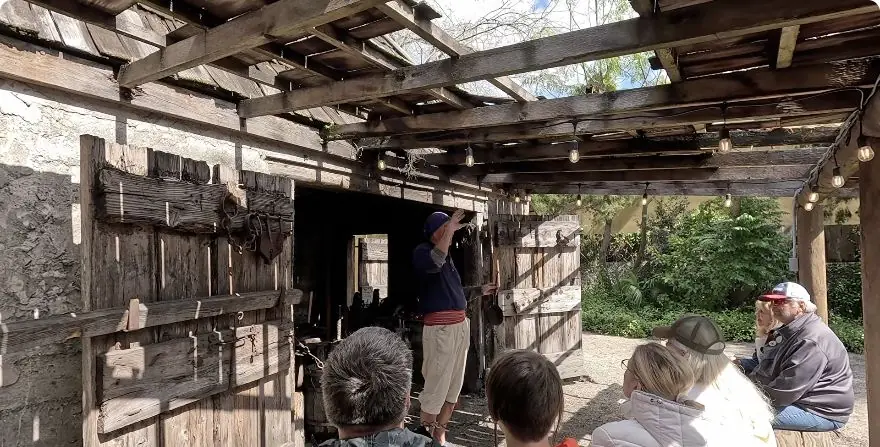
There is something refreshing about seeing a skill that cannot be reduced to a screen. It takes practice, attention, and a feel for the material. The forge does not perform on command, and that makes the demonstration feel more real. We are watching a process, not simply waiting for a finished prop.
“Think about the importance of iron in the wilderness.”
An Old House Makes History Personal
The De Mesa–Sánchez House brings the scale back down to daily life. Inside, the tour asks us to imagine a family living in a much smaller space, and to notice how the building changed as generations added to it.
The rooms, construction, and displays make the city’s changing history easier to picture. A house holds a different kind of story from a fort: where people gathered, how they adapted, and what home could mean before the comforts we take for granted.
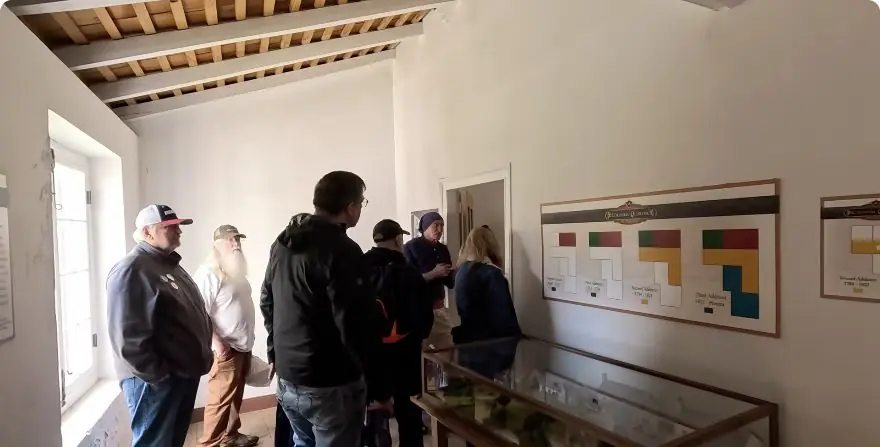
This is also a reminder that historic places survive because someone cares for them. Preservation gives us the building. Interpretation helps us understand why it matters.
“The whole idea there is … empathize with life.”
The Ocean Crossing Becomes More Than a Line on a Map
The seafaring portion of the tour asks a deceptively simple question: what would it have felt like to get here? Our guide uses a map and globe to discuss routes, provisions, navigation, and the uncertainty of a long voyage.
Thinking about fresh water, weather, cramped space, and the difficulty of knowing your position makes the Atlantic feel enormous again. It is easy to look backward from a world of GPS and forget how much knowledge, risk, and endurance a crossing required.
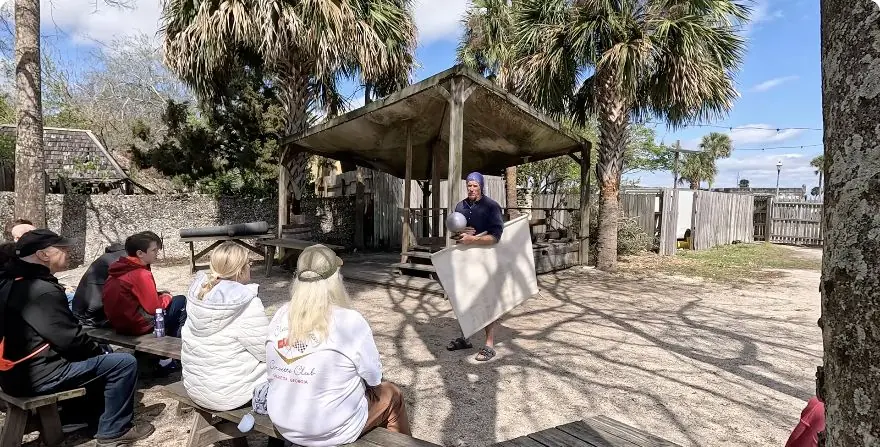
St. Augustine was founded by Pedro Menéndez de Avilés in 1565, more than four decades before Jamestown. It is the oldest continuously occupied European-established settlement in the continental United States. That wording matters: Indigenous communities were here long before European colonization, and the city’s history includes Native peoples, Africans both free and enslaved, and later arrivals whose lives are part of the story, too.
“Imagine being on this thing … for two months with about 20 other people.”
A Cannon’s Roar Gives the Lesson a Lasting Impression
The artillery stop brings the group together for a memorable finish. Our guide explains the cannon’s role and the teamwork behind operating it, then invites the children to help announce the demonstration. No cannonball is fired, but the sound makes the point.
The excitement works because it comes with context. This is not just a loud moment for the camera (that you know the kids love), it helps connect the defenses we see around town to the work, decisions, and risks of the people who relied on them.
Why Living History Matters to St. Augustine
A preserved building can tell us what survived. A living-history demonstration invites us to think about how people lived. Put the two together and a historic district becomes something we can understand, rather than simply photograph.
For us, the Colonial Quarter’s value is in that connection. Visitors ask questions. A child notices a tool. An adult rethinks the difficulty of a voyage. A guide turns a date into a story someone might remember years later. That exchange keeps history in everyday conversation.
Keeping history alive also means staying curious about the whole story. Colonial life included ingenuity and craftsmanship, but also conquest, enslavement, and conflict. Celebrating the skills on display does not require looking away from those realities. The best historical experiences give us a reason to keep learning.
A Shared Experience Across Generations
In our footage, children and adults share the benches and the questions. The demonstrations offer something tangible for younger visitors, while the stories of trade, home, travel, and defense give adults plenty to consider. You do not need to arrive with a head full of dates to enjoy it.
Take the guided experience, leave room for questions, and give yourself time to look around afterward. The watchtower adds another perspective on the bayfront for visitors comfortable with the climb. It is a lovely way to connect the stories on the ground with the city beyond the walls.
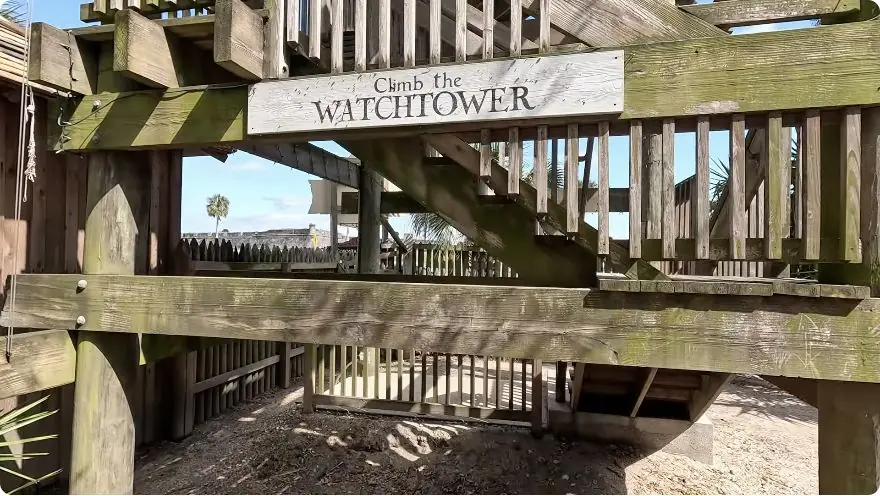
If someone asks us where to go beyond the usual downtown stroll, this is the kind of experience we want to share. It is right here in the historic district, but it gives you a reason to slow down and look more closely. St. Augustine’s past is not only in its stone walls. It is in the people willing to explain them—and the people willing to listen.
Keep exploring St. Augustine
Explore more things to do or see the city through our live cameras.
Based on our original Colonial Quarter tour footage and transcript. Historical context checked against the National Park Service and UF Historic St. Augustine. Images are stills from our video.
There’s More Around the Corner
One story down. A whole city still to explore. Find your next local read—or your next reason to get out and wander.